23.01.2026
How to Get German Citizenship this year: Requirements and Pathways

Up-to-date ways to obtain German citizenship in 2026: naturalization, marriage, and citizenship by descent. Key documents and typical timelines.
Key facts
-
New citizenship law: the standard naturalization period has been reduced to 5 years, and Germany has removed the general requirement to give up your previous citizenship.
-
Citizenship through marriage in 3 years.
-
Children born in Germany to foreign parents: a child can acquire German citizenship automatically + “choose one citizenship at 18” rule has also been removed — both citizenships can be kept.
-
What “integration” looks like in practice: you’ll generally need German at B1 or higher and to prove basic civic knowledge (typically via the naturalization test).
-
Fastest route for ethnic Germans: the Spätaussiedler (late repatriate) program can lead to a German passport within a few months after arrival.
-
Why a German passport matters: the right to live and work anywhere in the EU, strong options for business and employment, and wide visa-free travel opportunities.
Germany’s 2024 citizenship reform has made the path to a German passport clearer and, for many people, faster — which is why it matters both to long-term residents and to those planning a move. But “easier” doesn’t mean automatic: most refusals still come down to the basics — missing or inconsistent paperwork, language proof, or issues around income and residency history. A German passport is more than a stable status: according to the Henley Passport Index, it offers visa-free or visa-on-arrival access to 185 destinations, and EU citizenship gives you the freedom to live, work, and study in any EU country. In this guide, we break down the main routes — naturalization, citizenship through marriage, citizenship by birth and descent, and the late repatriate program — and explain what authorities actually check and what’s worth preparing in advance.
Germany’s New Citizenship Law
Starting 27 June 2024, Germany’s Citizenship Act (Staatsangehörigkeitsgesetz / StAG) was updated in a major way: multiple citizenship is now generally allowed. In practical terms, this means that when you naturalize, Germany usually no longer requires you to give up your previous nationality. At the same time, the standard residence requirement for naturalization was cut from 8 years to 5 years, which puts Germany among the faster options in the EU.
Spouses of German citizens can apply sooner: typically after 3 years of legal residence, as long as the marriage has lasted for at least 2 years. For children born in Germany to foreign parents, the jus soli rules were also made easier: if one parent has lived in Germany legally for more than 5 years and holds permanent residence, the child automatically becomes a German citizen at birth.
One important update to keep in mind: the “fast-track” naturalization route introduced by the 2024 reform — citizenship after 3 years for people with exceptional integration achievements (C1 German, and stable self-support) — was abolished in October 2025. Since 30 October 2025, the single minimum threshold is again 5 years.
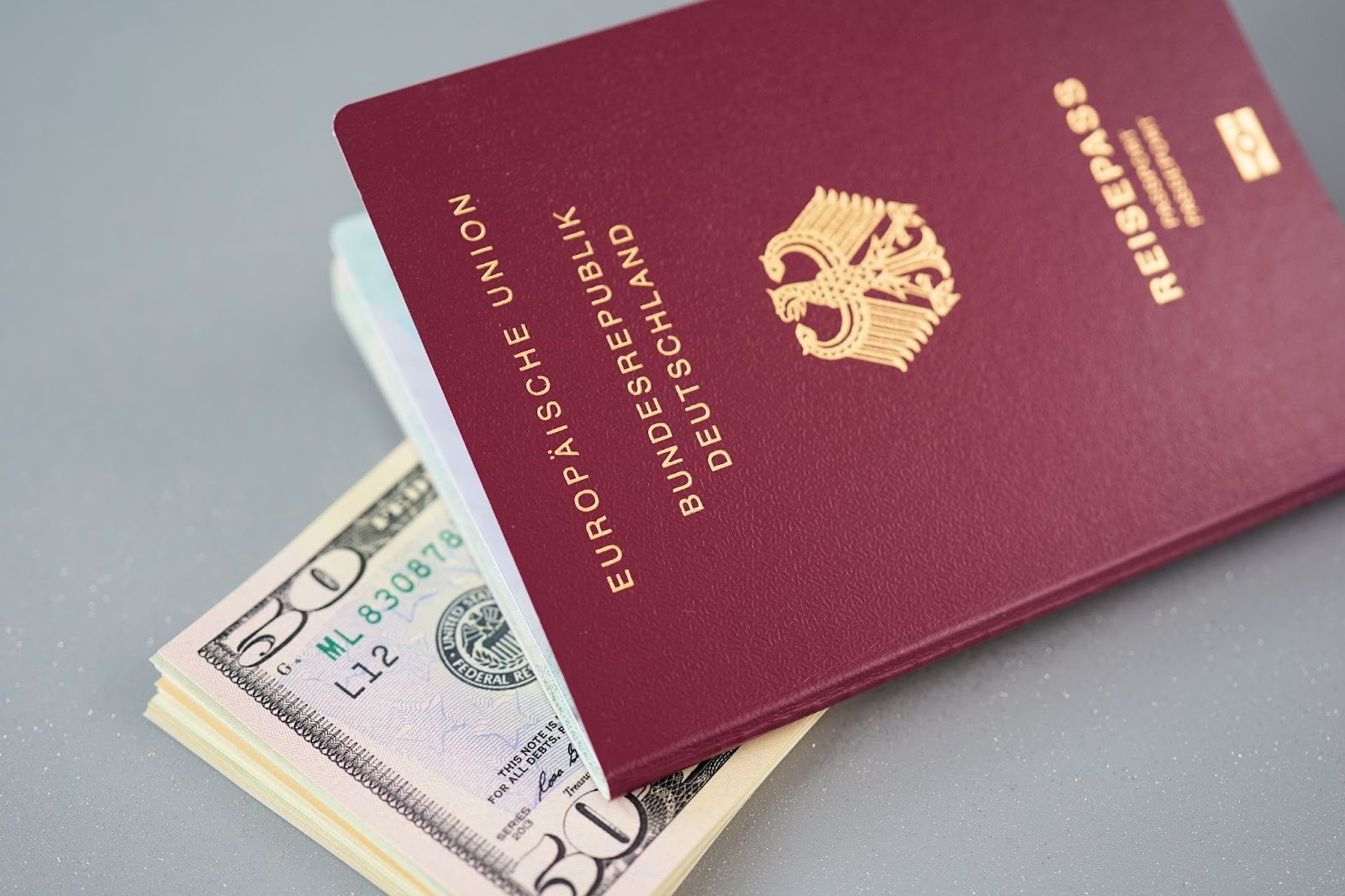
Benefits of a German Passport
A German passport gives you full German citizenship — and with it, a set of practical rights that go well beyond “just” having a residence permit:
-
Live and work anywhere in the EU without applying for a new residence permit in each country.
-
Stronger career options in a high-paying labor market (average salaries are often quoted around €4,200 gross/month, and unemployment is generally low).
-
More room to do business: easier company setup within the EU and direct access to the European market.
-
Visa-free travel to around 185 destinations, including the US, Canada, the UK, Australia, and Japan.
-
Consular protection abroad through German diplomatic missions.
-
Access to public education, solid healthcare, and social protections that are often broader for citizens than for temporary residents.
-
A more stable status than a residence permit or permanent residence, which makes it easier to plan your life long-term without worrying about visa renewals or changing permit rules.
Naturalization: the standard route
For most people who already live in Germany as legal residents, naturalization is the main path to German citizenship.
Step-by-step naturalization process
- Move to Germany legally and secure a residence status
This usually means entering with a national (Type D) visa and then getting a residence permit through work, studies, business/self-employment, or family reunification. - Live in Germany continuously for 5 years
Long absences can break the continuity — as a rule of thumb, leaving Germany for more than 6 months may cause problems. Continuity is typically supported by your residence permit/permanent residence documents, plus evidence of your life in Germany (employment or study records, medical documents if relevant, and sometimes bank statements). -
Reach B1 German and show basic civic knowledge
Language is proven with a certificate (commonly BAMF/DTZ) or, in some cases, proof of studying in German. Civic knowledge is usually proven by passing the Einbürgerungstest (naturalization test) or an equivalent qualification. The test has 33 questions, you can practice the question pool online, and it costs €25. -
Prepare your application package
You’ll need a full set of documents (listed below in the article), typically with certified translations, apostilles/legalization where required, and it’s smart to keep copies of everything. -
Submit your application to the citizenship authority
You apply at the relevant Staatsangehörigkeitsbehörde. Some offices also accept online applications. -
Wait for a decision
Processing times vary, but 18–24 months is a common estimate in many places. -
Take the oath and receive your naturalization certificate
Once approved, you attend the final step (often a short ceremony), take the oath/commitment, and receive the naturalization certificate — the document you’ll need to apply for your German ID and passport.

Typical document checklist for German citizenship by naturalization
While exact requirements can vary by city/state, applicants are usually asked for the following:
- A valid passport and your birth certificate (often with an apostille and a certified translation)
- A completed citizenship application form
- A biometric photo (35 × 45 mm)
- Your current German residence permit (eAT card)
- Proof of address registration (Meldebescheinigung)
- If applicable: child’s birth certificate, and marriage/divorce documents (often with apostille + translation)
- A German police clearance certificate (Führungszeugnis)
- A police clearance certificate from your country of citizenship (often with apostille + translation)
- Proof of income (employment contract, payslips, tax assessment/return) and housing (rental contract or proof of ownership)
- Proof of valid health insurance
- A German language certificate at B1 or higher
- Your Einbürgerungstest (naturalization test) result
- Proof of payment of the application fee (typically €255 for adults and €51 for children)
German Citizenship Through Marriage
Getting German citizenship through marriage is not automatic — you don’t receive a passport just because you got married. However, the spouse of a German citizen can usually apply for naturalization after 3 years of legal residence in Germany, as long as the marriage has lasted for at least 2 years and is still in place when the decision on citizenship is issued.
Apart from the shorter timeline, the requirements are largely the same as for standard naturalization: B1 German, the naturalization test, proof that you can support yourself financially, and a clean legal record (no serious criminal issues).
In real life, authorities also check that the marriage is genuine. They may ask for documents that show you actually live as a couple — for example, a marriage certificate (if it was issued abroad, it usually needs a translation and legalization/apostille), joint registration (Meldebescheinigung), a rental contract, shared bills or bank accounts, and other everyday “paper trails.” During an interview, you can also be asked basic questions about your family life.
Visa for marriage and long-term residence in Germany — on Terrana.org
Important: A sham marriage (Scheinehe) is a common reason for refusal. Using false information to obtain or keep a status can lead to criminal charges, cancellation of documents, and serious immigration consequences — including deportation.
Citizenship by Birth and Descent
German citizenship by descent (jus sanguinis)
A child automatically becomes a German citizen if at least one parent is a German citizen. In most cases, the place of birth — inside or outside Germany — doesn’t change that.
If the parents are not married and only the father is German, German citizenship usually requires legally valid paternity recognition (or a court procedure to establish paternity). This must be completed before the child turns 23.
There’s also an important “generational cut-off” rule (Generationenschnitt) to keep in mind: if the German parent was born abroad after 31 December 1999, lives abroad, and the child is also born abroad and acquires a foreign nationality, German citizenship may not pass automatically. In that case, you generally need to register the child’s birth within the first year through a German Standesamt (civil registry office) or a German consulate.
German citizenship by birth in Germany (jus soli)
Children born in Germany to foreign parents can acquire German citizenship automatically at birth if at least one parent has been living in Germany legally for more than 5 years and holds permanent residence.
Another key change since 27 June 2024: the “option obligation” (Optionspflicht) has been removed — meaning the child no longer has to choose one citizenship after turning 18 and can keep both.
Citizenship through adoption
If a child is under 18 and is adopted by a German citizen (and the adoption is recognized as valid under German law), the child typically acquires German citizenship automatically — there’s no separate naturalization process required.
Visa for reunification of a child with a parent/legal guardian in Germany — on Terrana.org

Late Repatriates Program in Germany (Spätaussiedler)
The Spätaussiedler program is one of the fastest and most straightforward ways for ethnic Germans and their descendants from the former USSR and Eastern Europe to obtain German citizenship. Unlike standard naturalization, you don’t typically have to spend years moving from a residence permit to permanent residence first. Citizenship is acquired through late repatriate status and the issuance of a special certificate under § 15 BVFG.
Key facts
-
It can cover the whole family: not only the main applicant, but also a spouse and descendants (children, grandchildren, etc.) — as long as they are included in the admission decision.
-
No passport “at the border”: the process usually starts with registration and allocation, then the certificate is issued, and only after that do you apply for a German ID card and passport. From arrival to documents, it often takes a few months, depending on the federal state and how busy the authorities are.
Who can qualify
In the “classic” scenario, applicants are people with German roots from the former Soviet republics or Eastern Europe whose family history fits the legal cut-off dates — for example, families who were living in the region voluntarily from 8 May 1945, or who were affected by deportation/forced relocation from 31 March 1952, as well as descendants born before 1 January 1993.
In practice, this means the program is aimed at ethnic Germans and their descendants who still live in the former USSR/Eastern Europe and apply before moving to Germany (applications are usually filed from the country of residence; in some cases via a consulate or an authorized representative).
Requirements for the applicant and family
The main task is to prove German ethnic affiliation and meet the language conditions. Under the rules, “German identity” can be shown in part through language — the main applicant is generally expected to have German at around B1 level. A spouse and adult family members included in the case often only need basic German (A1).

Typical documents applicants prepare
Every case is different, but the logic is the same: build a documented line back to the German ancestor and support it with official records. Commonly requested documents include:
- Application questionnaires/forms (S or A) for the Aufnahmeverfahren (filled out in German);
- Civil status records: birth, marriage, divorce, and adoption certificates for all relevant generations;
- Archival proof of German nationality/ethnicity (Soviet or national documents, passport entries, registry records, archive certificates, etc.);
- Military documents (Wehrpass/Soldbuch or similar), plus deportation/internment records or proof of German schooling if available;
- Police clearance certificates (age thresholds vary; for visa purposes, 14+ is often used);
- Employment record books (often requested for people born before 01.01.1974);
- Proof of language: for the main applicant, a B1-level test/certificate; for adult family members included, typically A1.
How the process goes
-
Collect archival documents and build a solid evidence package (often with help from specialists who work with archives).
-
Language proof: after submission, the BVA may invite the applicant for a language check; they typically assess whether you can hold a simple conversation in German.
-
Submit the application to the Bundesverwaltungsamt (BVA): usually from your country of residence; in some cases via a German consulate or a representative in Germany.
-
Wait for a decision: timelines vary widely — from months to several years — and depend heavily on how complete and consistent the documents are.
-
If approved, you receive an admission decision (Aufnahmebescheid) (and inclusion decisions for family members, if applicable).
-
Apply for a national (Type D) visa at the German consulate/embassy based on the admission decision (visa processing can be quick, but depends on the country and workload).
-
Enter Germany → initial registration and allocation: late repatriates go through registration and are allocated to a federal state.
-
After you are registered at your place of residence, the BVA issues the certificate confirming status — and with it, citizenship is acquired, after which you can apply for a German ID card and passport.
Multiple citizenship in Germany
Since 27 June 2024, Germany has officially allowed multiple citizenship as a general rule. In other words, you can become a German citizen (or take another citizenship later as a German) without having to give up your previous passport in most cases. One point to remember: even if you hold two passports, each country can treat you only as its own citizen while you are on its territory — with all the rights and obligations that come with that status.

Why you might be denied of German citizenship
Most citizenship refusals look very similar: one of the mandatory requirements isn’t met, so the authority can’t approve the application. In practice, it’s often not just one issue but a combination — paperwork problems, missing or inconsistent translations, test results, income, or gaps in legal residence status.
Most common reasons for refusal are:
-
Errors or gaps in documents: typos, missing information, mismatched names/dates, unclear identity or citizenship status.
-
German below B1, or trying to prove language skills with a questionable or fake certificate.
-
Failing the Einbürgerungstest (you need at least 17 correct answers out of 33).
-
Not being financially self-sufficient: as a rule, relying on certain social benefits can be a problem (exceptions exist, but they’re assessed case by case).
-
A criminal record in Germany or abroad, and/or ongoing criminal proceedings.
-
No appropriate residence status (visa/residence permit/permanent residence) or violations of immigration rules.
-
Security concerns / lack of commitment to Germany’s constitutional order, including antisemitism or other extremist or hate-based views.
-
Suspected sham marriage, especially if your route to citizenship is tied to family status.
-
Long periods outside Germany: being abroad for more than 6 months in a row can break the “continuous residence” requirement.
What to do if you were refused
Start by reading the refusal letter — it always states the reason. If it’s a fixable issue, correct it and reapply. If you believe the refusal is wrong, you can appeal within the deadline — ideally with the support of an immigration lawyer.
Can You Lose German Citizenship?
Yes — but in Germany it’s usually not a matter of an official “taking it away.” In most cases, citizenship is lost only in very specific situations defined by law, and those situations are relatively limited.
-
Voluntary service in a foreign military. A German citizen can lose their citizenship if they voluntarily (for example, under a contract) join the armed forces of a foreign state whose citizenship they also hold, without prior approval from Germany’s Ministry of Defence. There’s an important exception where approval is generally considered granted in advance — for citizens serving in the armed forces of EU, NATO, or EFTA countries, as well as Australia, Israel, Japan, South Korea, and New Zealand.
-
Citizenship obtained by fraud. If authorities later discover that naturalization was granted based on deliberately false information or the intentional concealment of relevant facts, it can be revoked retroactively.
-
Terrorist activity. Citizenship can be lost for active participation in combat operations of a terrorist organization abroad — but only if the person would not become stateless. In practice, this means it mainly applies to people who hold another citizenship in addition to German.
German citizenship is now accessible through different pathways, but for most people the most common and straightforward route remains naturalization after 5 years of legal residence — the standard timeline since the 2024 reform. The law has genuinely made the process faster and more flexible by allowing multiple citizenship, but “faster” still doesn’t mean “automatic.” Strong German skills, financial self-sufficiency, a clean immigration record, and real integration into everyday life are still the pillars of a successful application.
If you’re just getting started, the most practical plan is simple: secure the right residence status, work steadily toward the required language level, and start collecting and checking documents early to avoid delays. And if your case is complex — gaps in residence history, past convictions, tricky paperwork, family-based routes, or a late-repatriate line — it’s often worth talking to immigration specialists to save time and reduce the risk of refusal.
Official sources
-
German Citizenship Act (StAG): https://www.gesetze-im-internet.de/stag/
-
Federal Foreign Office (Germany): https://germania.diplo.de/
-
Federal Office for Migration and Refugees (BAMF): https://www.bamf.de
-
Federal Office of Administration (BVA): https://www.bva.bund.de
More articles on this topic

07.05.2026
Электронная виза в Италию с июня 2026: что изменится для россиян на самом деле

30.04.2026
Germany Opportunity Card 2026: Chancenkarte Requirements, Points, Costs & Application Plan

23.04.2026
Apostille and Translation for Visa & Residence Permit: What Documents You Need and Common Mistakes

16.04.2026
Visa-Free South Africa in 2026: When to Go and How to Plan a Cape Town – Garden Route – Safari – Namibia & Botswana Trip

