16.01.2026
How to Get a Visa to China: Visa-Free Entry Conditions and Application Costs

How to get a visa for China? Electronic visa, Tourist visa (L visa): list of required documents, application process, how long you can stay without a visa. Rules for visa-free entry to China.
In 2026, traveling to China for tourism has become noticeably easier, but the country cannot be considered fully “visa-free.” A temporary visa-free regime applies to certain nationals; however, strict entry rules, controls on length of stay, and mandatory digital procedures remain in force. Below is an up-to-date and practical overview: whether you need a visa to China, when you can travel without one, which documents are checked at the border, what an Entry Card is, and in which cases obtaining an L visa is unavoidable.
This information is relevant for travel to Mainland China, that is, the territory of the People’s Republic of China, excluding special administrative regions.
— Visa-free stay in China is allowed for up to 30 calendar days per trip.
— For stays exceeding 30 days, a Tourist visa (L visa) is required.
— Starting November 20, 2025, the electronic Entry Card is mandatory.
— The passport must be valid for at least 6 months from the date of entry.
— Registration at the place of stay is mandatory within 24 hours.
— For long-term trips and non-standard purposes, a visa is required.
What Is Required for Entry to China: Documents and Requirements
Even under a visa-free regime, border control in China remains strict. All required documents are thoroughly checked.
For entry, the following documents are necessary:
— a passport valid for at least 6 months;
— at least two blank pages for entry stamps;
— a return ticket or a ticket to a third country;
— proof of accommodation for the entire stay in the country;
— an electronic Entry Card with a QR code;
— proof of financial solvency: a bank statement in the traveler’s name or cash; either option is acceptable, based on approximately 100 USD per day per person.
Medical insurance is not formally mandatory, but its absence may result in additional questions at passport control, especially for longer itineraries or connecting flights.
Visa-Free Transit in China
China maintains several visa-free transit schemes, which are often confused with standard visa-free entry.
Available options:
— 24-hour transit: available at international airports in China; the ability to exit the transit zone depends on the airport.
— 72/144-hour transit: available in specific cities (Beijing, Shanghai, Guangzhou, etc.) and only through designated airports.
— 240-hour transit (10 days): available through a limited list of airports and border checkpoints.
You can determine which transit option applies to you based on two factors: the city of entry and the duration of the layover. Current lists of entry points and conditions are published in official sources:
— National Immigration Administration of the PRC (24 / 72 / 144-hour transit)
— Official explanations regarding extended transit (240 hours)
Mandatory conditions for visa-free transit include a ticket to a third country, compliance with the permitted area of stay, and no domestic flights beyond the authorized zone.
Electronic Arrival Card (Entry Card)
The Entry Card is a digital migration card that has fully replaced paper forms. As of November 20, 2025, it is mandatory for all foreign nationals entering China, regardless of visa status.
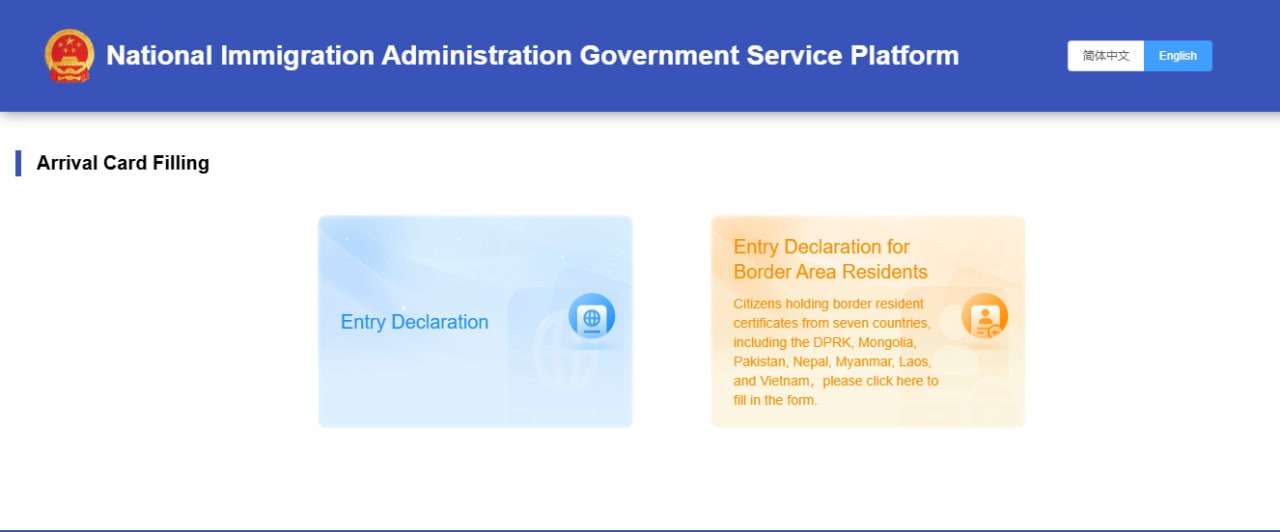
How to Complete the Arrival Card for Entry to China
-
Visit the official website or open the form via a QR code at the airport, or through WeChat or Alipay.
-
Enter passport details.
-
Select the purpose of the visit: Tourism, Business, Visit relatives, or Transit.
-
Provide the address of stay in China.
-
Enter the flight number and date of arrival.
-
Add contact details.
-
Receive and save the QR code.
-
Present the QR code at passport control.
The QR code is valid for 24 hours, so the card should be completed on the day of departure or shortly before.
How to Obtain a Tourist Visa to China
If the trip exceeds 30 days or the purpose of travel does not fall under the visa-free entry conditions, it is necessary to obtain a tourist visa (L visa). Within the tourist category, there are two visa options that differ in the format of the trip and conditions of stay.
The Tourist visa (L visa) is intended for individual travelers. The validity period may range from 3 months to 10 years. The permitted length of stay is from 1 to 3 months per entry. Depending on the itinerary and travel history, the visa may be single-entry, double-entry, or multiple-entry. The consular fee varies from USD 23 to USD 68, depending on the visa type and number of entries.
The Tourist group visa is designed for participants of organized tours. The validity period of such a visa ranges from 1 day to 3 months, with a permitted stay of up to 1 month. Only one entry is allowed. The consular fee is USD 23.
Documents Required for a China Visa
To apply for a China visa, a standard set of documents is required:
-
Passport valid for at least 6 months on the date of application, with at least two blank pages for visa stamps. If there are old Chinese visas, a copy of the previous passport may be required.
-
Completed visa application form via the COVA portal. The form is completed online on the official platform of the Chinese consulate, then printed and signed by the applicant. All information must exactly match the passport and supporting documents.
-
Digital photograph (33 × 48 mm). The photo is uploaded when completing the application form and must be taken against a light background, without headwear or glasses, with a neutral facial expression. The file must meet the visa center’s technical requirements.
-
Flight and accommodation bookings. Proof of round-trip flight or itinerary with departure to a third country, as well as hotel reservations for the entire stay or an invitation from the host.
-
Employment certificate or bank statement. For employed applicants: a letter from the employer stating position and income. For unemployed applicants: a bank statement confirming financial means of at least USD 100 per day of stay.
-
Medical insurance. The policy must be valid in China and cover the entire trip. No formal minimum coverage amount is set, but in practice insurance with coverage of at least USD 30,000 is recommended to avoid questions during application review and at passport control. Although insurance is not strictly mandatory, having it significantly reduces the risk of additional scrutiny.
For children, a birth certificate must be provided. If a child is travelling with only one parent or with third parties, a notarized consent to travel from the absent parent or both parents is required. The consent must specify the destination country, travel dates, and details of the accompanying person. In some cases, the visa center may request copies of the parents’ passports or documents confirming guardianship.

Fees and Processing Times
— Consular fee is calculated based on the current exchange rate.
— Applicants should include the visa center’s service fee in their planning.
— Standard processing time — from 3 to 15 business days.
— Expedited processing is available for an additional fee.
Current fees and requirements are published on the official website of the China Visa Application Service Center: https://www.visaforchina.cn/ and on the website of the Embassy of China: http://ru.china-embassy.gov.cn/rus/.
Entry Rules for Citizens of Certain Countries
Entry rules vary depending on citizenship. Below is a brief overview for selected countries.
Visa to China for citizens of Belarus
Visa-free entry for up to 30 days has been in effect since August 10, 2018. The maximum allowed stay is 90 days per year.
Visa to China for citizens of Kazakhstan
Visa-free entry for up to 30 days has been in effect since November 10, 2023. A maximum of 90 days per six-month period is allowed.
Visa to China for citizens of Armenia
Visa-free entry for up to 30 days was introduced on June 1, 2025. The limit is 90 days per six-month period.
Visa to China for citizens of Uzbekistan
Visa-free entry for up to 30 days has been in effect since June 1, 2025. The maximum is 90 days per six-month period.
Official explanations of visa regimes are published on the websites of diplomatic missions and immigration authorities of China.

Conclusion
In 2026, tourist travel to China has become easier, but still requires careful compliance with the rules. The visa-free regime for many nationals permits stays of up to 30 days but does not exempt travelers from passport control, financial checks, or the mandatory completion of the Entry Card. For longer itineraries, non-standard purposes, and repeat travel, applying for a Tourist visa (L visa) through the official visa center remains the most reliable option.
More articles on this topic

21.05.2026
Digital Nomad Visa: countries, taxes, income requirements, underrated destinations

15.05.2026
Business-Based Residence in Serbia: Sole Proprietor, LLC and Real Activity Requirements

30.04.2026
Germany Opportunity Card: requirements, points, costs & application plan

23.04.2026
Apostille and translation for Visa & Residence Permit: what documents you need and common mistakes

